

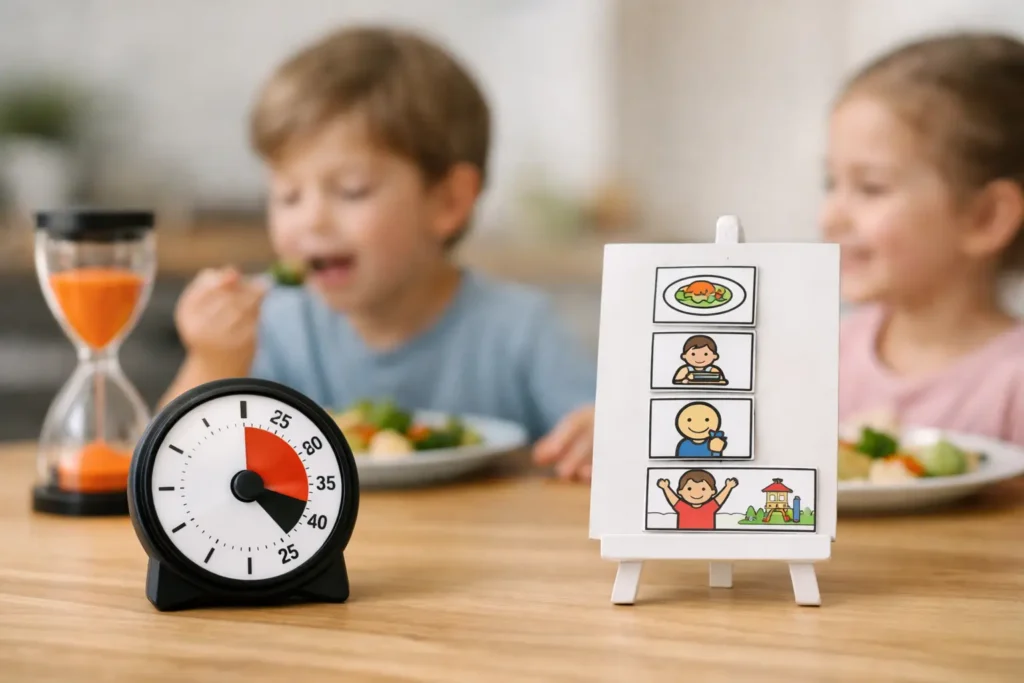
The timer is ticking, your child is watching the clock, and the broccoli is still untouched. For many families, the question of meal timers versus visual prompts is really a question of what kind of dinner you want to create: one that feels like a race, or one that gives your child a reason to stay curious.
Timers can be useful in the right moment. But when picky eating is already emotional, a countdown can turn one small bite into a big standoff. Visual prompts offer a different kind of motivation. Instead of asking children to beat the clock, they invite them to take part in a playful reveal, one bite at a time.
Meal Timers Versus Visual Prompts: The Big Difference
A meal timer focuses attention on time. It says, “We have 10 more minutes at the table,” or “Take three bites before the timer goes off.” That structure can help some children understand when a meal begins and ends, especially if they tend to wander away from the table or stretch dinner into an hour-long event.
But a timer does not make the food more appealing. In fact, for a child who already feels nervous about an unfamiliar texture, smell, or color, ticking seconds can add pressure. The message may land as, “Hurry up and do the hard thing,” even when that is not what you mean.
Visual prompts focus attention on progress and discovery. A picture slowly appears. A path fills in. A silly character gets closer to a celebration. Each bite gives the child an immediate, visible win. The meal is no longer only about what is on the plate. It becomes a small game they can choose to play.
That difference matters because children ages 2 to 8 are often motivated by what they can see right now. Waiting for dessert, earning a reward later, or hearing that a food is healthy can feel far away. Watching a surprise appear after a bite feels immediate, clear, and exciting.
When Meal Timers Can Help at the Table
Timers are not automatically the bad guy. They can be a gentle family routine when they are used to set boundaries around the meal, not to demand bites.
For example, a parent might say, “We are going to sit together for 15 minutes, then dinner is all done.” That can be reassuring for a child who likes predictability. It can also help parents avoid endlessly reopening negotiations after everyone else has finished eating.
A timer may work well when your child is comfortable with the foods being served but gets distracted easily. It can be a simple cue that says, “This is our eating time,” without turning you into the person who has to repeat the reminder every 30 seconds.
The trouble starts when the timer becomes a consequence. Statements like “Finish your chicken before the buzzer” or “You cannot leave until you take five bites” can make dinner feel like a test. Some children may rush, shut down, bargain, or become even more determined not to eat. The food becomes the battlefield, and nobody wants that.
If you use a timer, keep its job small. Let it mark the routine, not measure your child’s success.
Why Visual Prompts Often Feel Better for Picky Eaters
Picky eating is rarely solved by one perfect sentence or one magical food. It usually improves through many low-pressure encounters: seeing a food, smelling it, touching it, licking it, and eventually feeling ready for a bite. That takes patience, especially on a Tuesday night when you have already answered 47 questions and dinner is getting cold.
Visual prompts meet children in the moment without turning their hesitation into a problem. Rather than saying, “Just try it,” you can offer an invitation: “Want to see what happens after your next bite?”
That small shift gives the child something positive to move toward. It also helps take the spotlight off the food itself. A child does not have to declare that they suddenly love peas. They just have to decide whether they want to reveal a little more of the picture.
This approach can be especially helpful with new foods. New food can feel enormous to a young child, even when it is only one tiny piece of bell pepper. A visual game breaks the challenge into manageable moments. One bite is one bite. It does not have to mean cleaning the plate, loving the food forever, or doing everything perfectly.
With Easy Eaters, each bite reveals more of an image and brings children closer to cheerful celebrations and badges. Parents get to offer encouragement without resorting to pleading, bargaining, or promising a separate treat afterward.
The Hidden Benefit: Less Parent Pressure
The biggest win is not always the number of bites. Sometimes it is the moment you realize you did not spend dinner negotiating.
When a child is focused on a visual prompt, parents can step out of the role of food referee. You can sit nearby, share a conversation, and celebrate effort with a simple, calm response: “You did it. Look what you uncovered.”
That matters because children are very good at sensing when a meal has become emotionally charged. The more worried or frustrated a parent feels, the more likely a cautious eater may resist. This is not because you are doing anything wrong. It is because dinner can quickly become a high-stakes moment for everyone.
A playful prompt lowers the temperature. It gives you a neutral third thing to talk about besides whether your child has eaten enough. For many families, that alone makes the table feel lighter.
How to Choose Between a Timer and a Visual Prompt
Think about the challenge you are actually trying to solve. If your child needs help understanding that meals have a beginning and an end, a gentle timer may support the routine. If your child is refusing foods, dreading the table, or getting stuck in power struggles around bites, visual prompts are usually the more natural place to start.
You can also use both, with very different jobs. Let a timer quietly guide the length of the meal. Let the visual prompt handle the motivation. The timer says, “We will be together at the table for a little while.” The game says, “There is something fun to discover if you want to try a bite.”
The key is keeping both tools free from threats. Avoid using the clock to create urgency or the game to force a clean plate. Your child should still be allowed to listen to their body. They may be hungry, cautious, tired, excited, or simply done for the day. A positive tool works best when it is an invitation, not a test they can fail.
Make the First Try Easy
Start with a food your child already accepts, even if it is something simple like crackers, strawberries, or pasta. This lets them learn the game without also facing a big food challenge. Once the experience feels fun and familiar, you can place a tiny amount of a less familiar food alongside their safe foods.
Keep your words light. Instead of asking, “Are you going to eat the carrot?” try, “I wonder what part of the picture you will reveal next.” Celebrate participation, not perfection. A bite is progress. Touching a new food may be progress too.
And remember that calm meals are built over time. There will be nights when your child is not interested, when the new food stays on the plate, or when the game only lasts a minute. That does not erase the good moments. It simply means your child is learning at their own pace.
The best mealtime tool is the one that helps your family trade pressure for connection. When dinner feels less like a countdown and more like a chance for a small, happy win, children have more room to surprise you.