

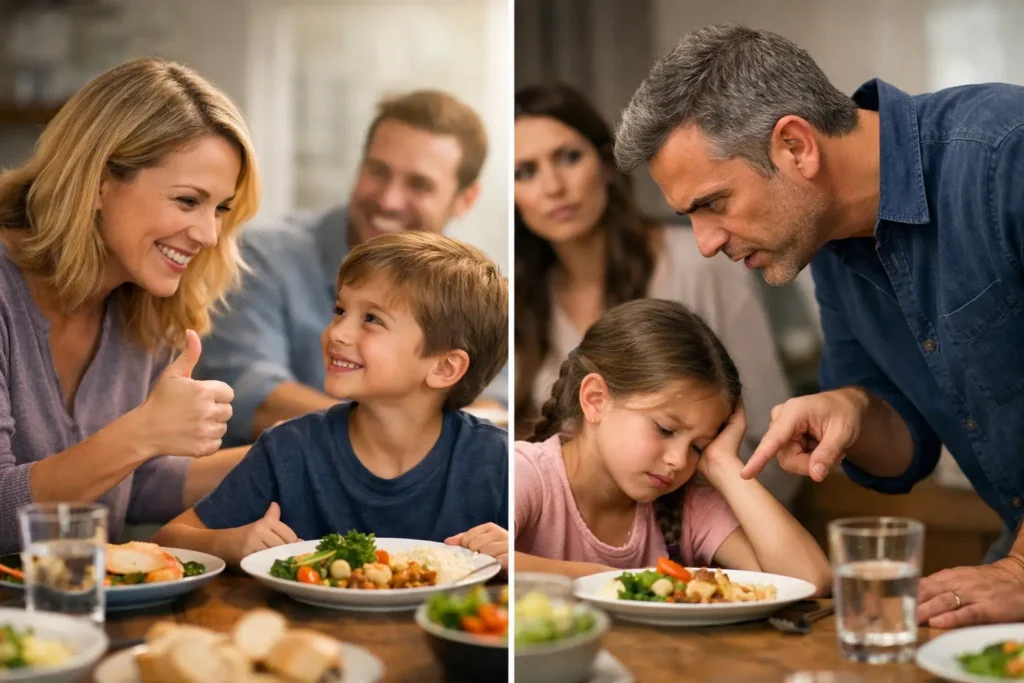
When a child pushes away dinner for the third night in a row, even the most patient parent can feel their shoulders tighten. The difference between praise versus pressure often comes down to what happens next. A cheerful “You gave that a try!” can keep the door open. A worried “Just one more bite for me” can make that same bite feel much bigger than it needs to be.
Parents do not create pressure because they do not care. Usually, it comes from caring deeply. You want your child to grow, get the nutrition they need, and stop living on crackers and the one brand of yogurt they will accept. But children can sense urgency, even when it is wrapped in a sweet voice. At the table, less pressure often creates more room for progress.
Why Praise Versus Pressure Matters for Picky Eaters
Picky eating is rarely solved by one perfect meal or one magic phrase. It is built through many small experiences: seeing a food, smelling it, touching it, licking it, or taking a tiny bite. When every interaction feels like a test, children may become more determined to avoid the food – and the table itself.
Pressure can sound obvious, like threats, bargaining, or insisting that a plate must be clean. It can also be quieter. Repeated reminders, watching every bite, sighing, or celebrating so intensely that a child feels they must perform can all raise the stakes.
Praise is different when it notices a child’s effort without demanding a particular result. It says, “You were curious about that carrot,” rather than, “Finally, you ate a carrot!” One invites exploration. The other can make a child feel that eating is how they earn approval.
That does not mean parents should act as if food choices never matter. You are still allowed to set the meal, offer variety, and keep a predictable routine. The goal is not to give up your role. It is to make the table feel safer while your child learns.
What Pressure Can Look Like at Dinner
Pressure often sneaks in during hard moments. You may say, “Two more bites and then you can have dessert,” because you need dinner to move along. Or you may offer a reward because you are tired of food going untouched. Those choices can work in the moment, and that is why they are so tempting.
The trade-off is that your child may start to see the food itself as an obstacle between them and the thing they really want. They eat to escape the situation, not because they are building comfort with the food. For some children, especially those who are sensitive, anxious, or very strong-willed, this can make refusal even stronger next time.
Pressure can also turn familiar foods into a negotiation. “You liked chicken last week” may be true, but children’s appetite and preferences can change from day to day. A child who happily ate blueberries on Tuesday may reject them on Thursday. That is frustrating, but it is not proof that you have failed or that your child is being difficult on purpose.
The Signs the Stakes Are Too High
If your child cries, freezes, argues, hides food, gags when they feel watched, or asks to leave the table, it may be time to lower the pressure. These reactions do not mean you should never offer new foods. They mean the approach may need to become gentler.
A calmer goal can be surprisingly powerful: let the new food simply be on the plate. Let your child decide whether they are ready to interact with it. Progress may look small from the outside, but small steps are how confidence grows.
How to Give Praise That Actually Helps
Helpful praise is specific, light, and focused on bravery or curiosity. It does not require your child to finish a serving, like a food, or repeat the same action tomorrow.
Instead of saying, “Good job eating your broccoli,” try, “You touched the broccoli even though it was new.” Instead of, “You are such a good eater,” try, “You listened to your body and tried one bite.” These phrases tell your child what they did without attaching their worth to what they ate.
Keep your reaction calm, too. A huge celebration after one bite can be fun for some children, but it can feel like a spotlight for others. Watch your child’s cues. If they beam and ask for a high-five, enjoy the moment. If they look away or get tense, a simple smile and “Nice trying” may be enough.
Let Your Child Own the Win
Children are more likely to return to a food when they feel the choice was theirs. You can offer two low-pressure options, such as whether they want a food on their plate or in a small bowl beside it. You can ask whether they want to smell it, touch it with a fork, or leave it alone today.
This is not about letting children run the kitchen. It is about giving them a little control within boundaries you set. You choose what is offered and when the meal happens. Your child gets room to decide how much, if any, they eat.
Make Trying Food Feel Playful, Not Performative
A playful prompt can shift the mood fast. Maybe the green bean is a “tree,” a strawberry has tiny seeds to count, or a crunchy pepper makes a silly sound. Play works best when it is an invitation, not a trick. If your child says no, let no be an acceptable answer and move on.
Games can be especially useful when meals have become loaded with tension. Easy Eaters turns bite-taking into a simple visual reveal, with little surprises and celebrations that move forward one bite at a time. The focus is not on forcing a clean plate or making a child eat a certain food. It is on making a brave try feel achievable and fun.
The key is to avoid making the game another contract. Do not frame it as, “You have to finish this to win.” Let it be a friendly tool that helps dinner feel lighter. A child can pause, stop, or try again another day.
A Calmer Script for Tough Mealtimes
When dinner starts sliding toward a battle, simple language helps. You might say, “This food is here if you want to try it.” If your child refuses, respond with, “Okay, you do not have to eat it today.” Then keep the meal moving with ordinary conversation.
If they take a bite and immediately spit it out, avoid reacting with disappointment. Try, “That texture was not for you right now. Thanks for giving it a try.” If they ask for a different meal after rejecting what was served, you can hold a kind boundary: “This is what we have tonight. You do not have to eat it.” Including at least one familiar food at the meal can make that boundary feel more manageable.
This approach may feel slower than pushing for bites. In the short term, it sometimes is. But calmer repetition can build something pressure cannot: trust. Your child learns that new foods will appear, that they will not be forced, and that trying is safe.
When More Support May Help
Most picky eating is a normal phase, even when it is exhausting. Still, trust your instincts if your child regularly coughs, chokes, gags, has pain while eating, loses weight, avoids entire texture groups, or has an extremely limited range of accepted foods. A pediatrician or qualified feeding professional can help you understand what is going on and what support fits your child.
For everyday dinner struggles, start smaller than you think you need to. Put one tiny piece of a new food beside a familiar favorite. Notice curiosity. Protect the calm. Your child does not need a perfect plate tonight. They need to know that the dinner table is a place where they can learn, laugh, and try again tomorrow.